Have you ever looked in the mirror or seen a photo of yourself and noticed that your smile seems a little… tilted? You might be tilting your head to compensate, or perhaps one side of your teeth looks lower than the other. In the dental world, we call this an “occlusal cant,” but you probably know it simply as a slanted or canted smile. If this sounds familiar, I want you to know that you are not alone, and more importantly, it is something we can fix.
As a cosmetic dentist, I see patients every day who feel self-conscious because their smile doesn’t line up perfectly with their eyes or the centerline of their face. A balanced smile is key to facial harmony. When that balance is off, it can affect your confidence. The good news is that we have incredible technology and techniques today to correct this. The main question usually comes down to the method: should we move the teeth, or should we reshape them?
In this post, I am going to walk you through everything you need to know about Canted Smile Correction. We will look at the differences between orthodontic solutions (like braces) and restorative solutions (like veneers), so you can understand which path might be right for your unique smile.
What Exactly is a Canted Smile?
Before we jump into the treatments, it helps to understand exactly what we are dealing with. A canted smile occurs when the horizontal plane of your teeth (the occlusal plane) is not parallel to the horizon or the line of your eyes. Imagine holding a ruler between your teeth; if the ruler isn’t straight compared to the floor, you likely have a cant.
This slant can be subtle, or it can be very obvious. It often happens because the teeth on one side of the jaw erupted further down than the teeth on the other side. However, it can also be skeletal, meaning the jawbone itself grew asymmetrically. Understanding the root cause—whether it is dental (just the teeth) or skeletal (the jawbone)—is the first step I take in determining how we approach your Canted Smile Correction.
The Psychological Impact of a Balanced Smile
We often talk about the mechanics of teeth, but I always like to address the emotional side of dentistry. Your smile is your greeting card to the world. When you feel good about it, you project confidence. When you are worried about asymmetry, you might hide your laugh or smile with your lips closed.
According to the American Academy of Cosmetic Dentistry, a staggering 99.7% of adults believe a smile is an important social asset. This data point highlights just how crucial facial symmetry is to our self-perception and social interactions. Correcting a cant isn’t just about vanity; it is about aligning your outer appearance with your inner confidence.
Approach 1: Orthodontics (Moving the Foundation)
When the issue is severe, or if you are looking to preserve your natural tooth structure entirely without any reshaping, orthodontics is often the first line of defense. This is the “slow and steady” approach. Orthodontics works by physically moving the position of your teeth and, to some extent, remodeling the bone that holds them.
How Braces and Aligners Help
Traditional metal braces or clear aligners (like Invisalign) apply constant pressure to the teeth. In cases of a canted smile, we aren’t just straightening crooked teeth; we are trying to intrude (push up) or extrude (pull down) specific teeth to level out the plane.
For example, if your smile is lower on the right side, an orthodontist might use specific mechanics to push those right-side teeth up while letting the left-side teeth settle down. This physically levels the horizon of your smile.
Advanced Orthodontics: TADS
For more complex Canted Smile Correction, orthodontists might use something called TADs (Temporary Anchorage Devices). These are tiny mini-screws placed temporarily in the jawbone. They act as an anchor to help pull teeth in directions that aligners or braces alone sometimes can’t manage. It sounds intense, but it is a very effective way to treat skeletal cants without surgery.
The Pros and Cons of Orthodontics
- The Pro: You keep your natural teeth intact. We aren’t shaving down enamel or adding porcelain. It is purely about position.
- The Con: It takes time. Orthodontic treatment can take anywhere from 12 to 24 months. Additionally, if the teeth themselves are worn down unevenly, moving them might straighten the roots, but the edges might still look slanted.
It is also worth noting that orthodontics has become incredibly common for adults. The American Association of Orthodontists reports that one in four orthodontic patients is an adult. It is never too late to move your teeth, but not everyone wants to wait two years for results.
Approach 2: Restorative Dentistry (The “Instant” Fix)
This is where my passion truly lies. Restorative cosmetic dentistry allows us to correct the visual appearance of a canted smile often in just a few visits. This approach is sometimes called “instant orthodontics,” though that term can be a bit misleading because we aren’t moving the roots—we are changing the visible shape of the teeth to create perfect symmetry.
If your cant is caused by uneven wear on your teeth, or if the slant is mild to moderate, restorative dentistry is often the superior choice because it addresses the shape, color, and alignment all at once.
Porcelain Veneers: The Game Changer
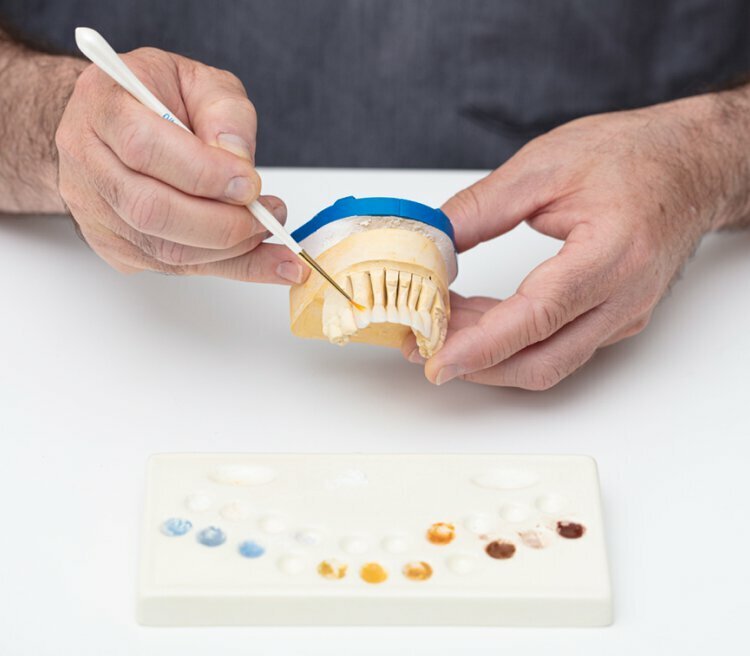
Porcelain veneers are thin shells of medical-grade ceramic that are bonded to the front of your teeth. They are, in my opinion, the most versatile tool for Canted Smile Correction.
Here is how I use them to fix a slant:
Imagine your teeth are tilting down to the left. To fix this visually, I can design veneers that are slightly shorter on the left side and slightly longer on the right side. By carefully manipulating the length and the biting edge of the veneers, I can make the smile look perfectly parallel to your eyes, even if the roots of the teeth are still slightly tilted underneath.
This requires a very artistic eye. I have to look at your lip line, your gums, and your facial features. We aren’t just pasting white covers on your teeth; we are sculpting a new horizon line for your smile.
Dental Crowns
In cases where the teeth are heavily damaged or have large fillings, I might use dental crowns instead of veneers. A crown covers the entire tooth. This gives me even more control to change the orientation of the tooth. If a tooth is severely tilted, a crown allows me to build a new “straight” tooth over the tilted foundation.
The Pros and Cons of Restorative Dentistry
- The Pro: Speed and total transformation. We can fix the cant, the color, the shape, and gaps all at the same time. You walk out with a brand-new smile in a matter of weeks, not years.
- The Con: It is irreversible. To place veneers or crowns, we generally have to remove a small amount of natural enamel. It is a commitment to maintenance for the rest of your life.
The Role of Gum Contouring
Sometimes, a canted smile isn’t just about the white part (the teeth); it’s about the pink part (the gums). If your gum line is uneven—lower on one side than the other—your smile will look slanted even if the teeth are straight.
I often perform a procedure called a gingivectomy, or gum contouring, alongside veneers or after orthodontics. By using a laser to gently reshape the gum tissue, I can raise the gum line on the side that looks “heavy” or “low.” This creates symmetry at the top of the teeth. When we combine gum contouring with porcelain veneers, the results for Canted Smile Correction are absolutely stunning. It frames the teeth perfectly.
Orthodontics vs. Restorative: Which is Right for You?
So, how do you choose? When patients come to my practice, I look at three main factors:
1. The Severity of the Cant
If the tilt is extreme and involves the jawbone significantly, I will likely recommend starting with orthodontics. We need to get the foundation relatively level before we start building on it. If the cant is mild to moderate, restorative dentistry is usually sufficient to hide the asymmetry perfectly.
2. The Condition of Your Teeth
If you have pristine, perfectly shaped, white teeth that just happen to be tilted, it makes sense to use braces to move them. Why cut into perfect teeth? However, if your teeth are chipped, worn down, discolored, or have old fillings, moving them won’t fix those aesthetic issues. in that case, veneers are the smarter option because they fix the health, aesthetics, and the slant simultaneously.
3. Your Timeline
I have many patients who come to me getting ready for a wedding or a big career move. They cannot wear braces for 18 months. For these patients, restorative dentistry provides the immediate boost in confidence they need. We can plan, prep, and place veneers in a timeline that fits their life.
The Hybrid Approach
It is important to mention that it doesn’t always have to be one or the other. Some of the best makeovers I have done involved a hybrid approach. We might use limited orthodontics (like Invisalign for 6 months) to get the teeth in a better position, and then finish with veneers to perfect the shape and color.
This allows us to be more conservative with the tooth preparation. Since the teeth are straighter, I have to remove less enamel to place the veneers. It is the best of both worlds: the health benefits of orthodontics with the stunning beauty of restorative dentistry.
For more detailed information on how jaw alignment affects overall dental health, I recommend reading this article from Colgate’s Oral Health Center on Malocclusion, which explains the mechanics behind bite issues in depth.
My Philosophy on Smile Design
In my practice, I believe that no two smiles should look the same because no two faces are the same. Correcting a canted smile is about more than just using a level; it is about facial flow. I look at the pupillary line (the line between your eyes) and the midline of your face.
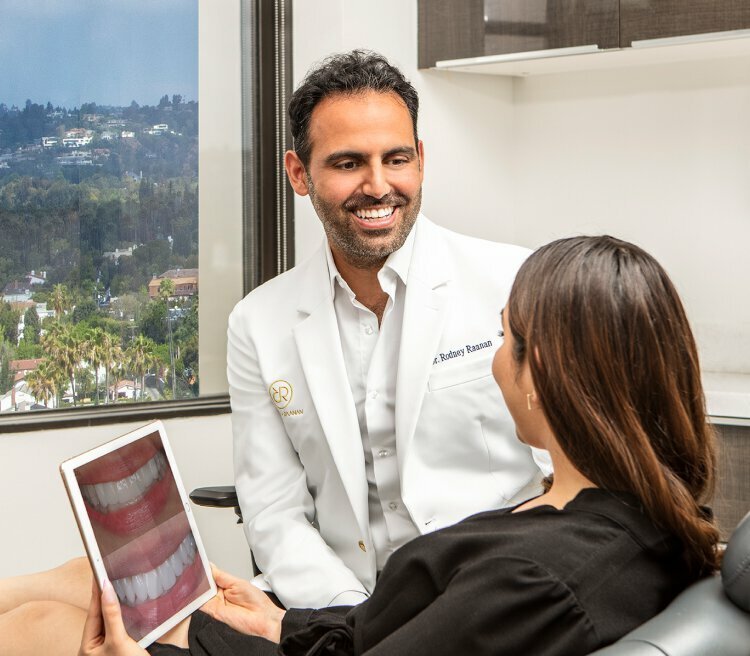
When I design a smile, I use digital imaging to show you exactly what the outcome will look like before we even touch a tooth. This is crucial for Canted Smile Correction. You need to see how shifting the line of your teeth will change your overall appearance. It takes the guesswork out of the process and ensures that we are on the same page.
Taking the Next Step
Living with a smile you are unhappy with takes a toll on you. You might not even realize how much energy you spend trying to hide your teeth until you don’t have to anymore. Whether the solution is braces, veneers, or a combination of both, fixing a slanted smile is one of the most rewarding procedures I perform because the change is so immediate and impactful.
If you have noticed asymmetry in your photos or in the mirror, I encourage you not to settle for it. There is a science and an art to leveling your smile, and it starts with a conversation. We can assess your dental health, look at the structure of your jaw, and map out a plan that gets you the straight, bright, and balanced smile you deserve.