We live in a world where we can get almost anything instantly. From fast food to same-day delivery on our online shopping, speed is often the priority. I completely understand why patients come into my office asking about Same Day Veneers. The idea of walking in with one smile and walking out a few hours later with a brand-new one is incredibly appealing. It sounds like magic.
However, when it comes to your face and your smile, I believe that magic shouldn’t be rushed. In my practice, we prioritize excellence, durability, and hyper-realistic aesthetics over speed. While technology in dentistry has advanced rapidly, there is a very strong case for why hand-crafted artistry still reigns supreme over machine-made convenience.
I want to take you behind the scenes of my process. I want to explain why we choose to take the extra time to create a bespoke smile for you, rather than relying on the “fast food” version of cosmetic dentistry. Here is why the patience required for custom porcelain veneers is the best investment you can make for your confidence.
Understanding Same Day Veneers: The Technology vs. The Art
To understand why we choose a different path, we first have to look at what Same Day Veneers actually are. This process generally utilizes a technology called CAD/CAM (Computer-Aided Design and Computer-Aided Manufacturing). In this scenario, a dentist scans your teeth, designs the veneer on a computer screen, and sends that design to a milling machine in the office.
That machine takes a solid block of porcelain or resin and carves out a veneer in about 15 to 20 minutes. It is a marvel of engineering. For crowns on back teeth, where function is the main goal and aesthetics are less critical, this technology is fantastic. However, when we are talking about the “social six”—the front teeth that define your smile and your personality—a machine simply cannot replicate the nuance of nature.
Teeth are not just white blocks. They are complex structures. They have layers, gradients of color, translucency at the edges, and specific textures that reflect light in unique ways. A milling machine cuts from a monochromatic (single color) block. While the dentist can add a little bit of external stain, it lacks the depth that comes from the inside out.
The Monolithic Block vs. The Layered Masterpiece
The primary reason I avoid Same Day Veneers for smile makeovers is aesthetic depth. Natural teeth are polychromatic. This means they are made up of many different colors and transparencies. The dentin (the inner layer) provides the warmth and color, while the enamel (the outer layer) provides the translucency and value.
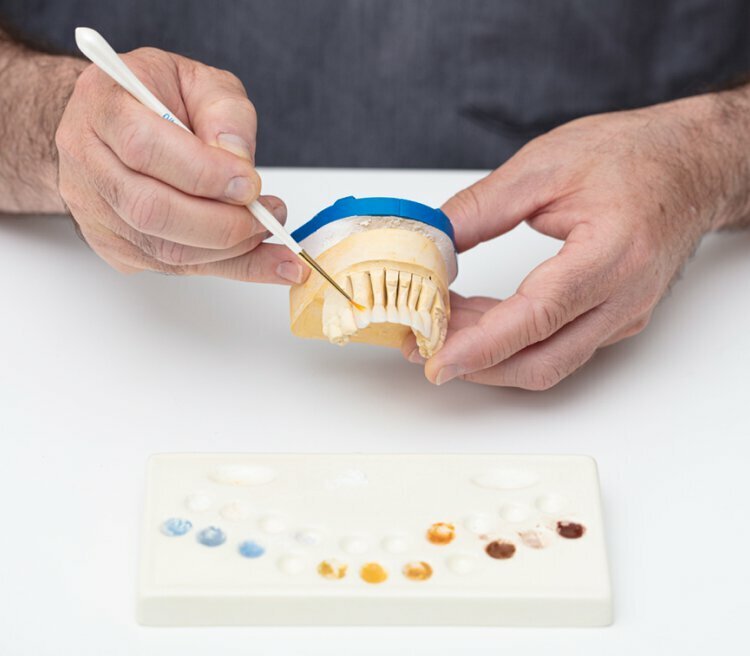
When we create hand-crafted veneers, I work with a Master Ceramist. This is an artist who specializes specifically in the structure of teeth. Instead of milling a veneer from a single block, the ceramist builds the veneer up by hand, layer by tiny layer, using a paintbrush and porcelain powder.
We might use a deeper, warmer shade near the gum line, a brighter shade in the middle, and a translucent, blue-gray tint at the biting edge to mimic natural enamel. This internal layering creates a “window” effect. When light hits a hand-layered veneer, it travels through the porcelain and bounces back, creating a life-like vitality. When light hits a milled, same-day veneer, it often hits a flat surface and stops. This can result in teeth that look “opaque” or “chiclet-like.”
The Importance of the “Trial Smile”
One of the biggest risks with Same Day Veneers is the lack of a “test drive.” In a same-day procedure, the veneers are designed, made, and permanently bonded to your teeth in a single visit. Once they are on, there is no going back without cutting them off.
I believe in a process that gives you complete control over the outcome. This is why we use temporaries. After I prepare your teeth, I place temporary veneers that are based on our initial design. You wear these prototypes for a few weeks. This period is absolutely critical for two reasons:
- Aesthetics: You get to live with your new smile. You can see how it looks in natural sunlight, in bathroom lighting, and in photos. You might decide you want the edges slightly rounder, or the color a tiny bit brighter. We can make those changes to the temporaries and transfer those details to the final porcelain.
- Function: We need to ensure your speech is natural and your bite is comfortable. If the veneers are too long, they might affect how you say “S” or “F” sounds.
Skipping this step to save time is a gamble I am not willing to take with your smile. The temporaries act as a blueprint for the ceramist, ensuring the final result is exactly what you envisioned.
Data Point: The Precision of Fit and Gum Health
Beyond how the teeth look, we have to talk about how they fit. The health of your gums depends on the “margin”—the microscopic line where the veneer meets your natural tooth. If there is a gap or a ledge, bacteria can accumulate, leading to gum inflammation, bad breath, and decay.
While milling machines are accurate, the human hand working under a microscope offers a level of refinement that is hard to beat. According to clinical evaluations in restorative dentistry, the marginal gap of a restoration is a key predictor of its longevity. Studies suggest that clinically acceptable marginal gaps should be less than 120 microns, but high-end hand-crafted veneer work often aims for margins as precise as 50 microns or less.
Achieving this level of precision requires a ceramist to examine the model under high magnification and trim the porcelain by hand. This ensures that the transition from tooth to veneer is seamless. Your floss should slide over it without catching, and your gums should remain pink and healthy. In my experience, mass-produced or rushed veneers often struggle to achieve this level of marginal integrity consistently.
The Human Element: Collaboration with a Master Ceramist
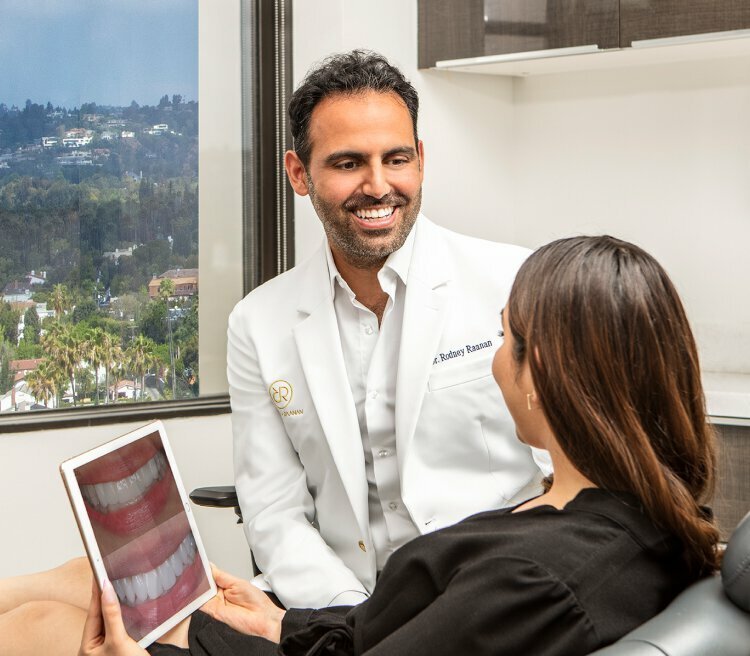
When you choose our practice, you aren’t just hiring a dentist; you are hiring a team. My relationship with my ceramist is like that of an architect and a builder. We communicate constantly regarding your case.
With Same Day Veneers, the “technician” is a computer algorithm. While algorithms are smart, they don’t have artistic intuition. They cannot look at a photo of your face and decide that a slightly softer angle on the canine tooth will complement your cheekbones better. They cannot adjust the texture of the surface to match the age and character of your smile.
My ceramist creates texture on the surface of the veneer that mimics natural tooth anatomy. Real teeth are not perfectly smooth like bathroom tiles; they have tiny grooves and ridges that break up light reflection. This texture is applied by hand before the final glazing. This artistic touch is what makes people say, “Wow, you have a beautiful smile,” rather than, “Wow, you have nice veneers.”
Longevity: An Investment in the Future
We are looking for a solution that lasts decades, not just years. Porcelain is an incredibly strong material, but the way it is fabricated matters. Hand-layered, feldspathic porcelain or pressed lithium disilicate (eMax) that is carefully treated in a lab oven often demonstrates superior structural properties compared to blocks that are milled quickly.
Data Point: When properly bonded and maintained, the survival rate of porcelain veneers is impressive. A study published regarding the long-term survival of veneers indicates that approximately 93% of porcelain veneers survive at 10 years, and 83% can survive up to 20 years.
Achieving these numbers requires perfect isolation, precise bonding protocols, and a restoration that fits perfectly. By rushing the fabrication process into a single appointment, the risk of technical error can increase. I prefer to take the time to ensure the bonding environment is perfect and the porcelain is cured to its maximum strength in a specialized laboratory furnace.
For more information on the standards of cosmetic dentistry and materials, you can read insights from the American Academy of Cosmetic Dentistry (AACD), which sets the bar for excellence in our field.
The Customization of Color
Let’s discuss color in more detail. Many patients come in wanting “white” teeth. But in the world of high-end cosmetic dentistry, there are dozens of shades of white. A flat, opaque white looks artificial—like a piano key.
With hand-crafted veneers, we can control the “value” (brightness), “chroma” (intensity of color), and “hue” (the actual color family). We can add a hint of translucency to the biting edges to make the teeth look youthful. We can add a very faint amber tone near the gum line to make the teeth look natural and integrated with the soft tissue.
With Same Day Veneers, you are generally limited to the shade of the block available. If the block is shade BL1 (a very bright white), the whole tooth is BL1. It lacks the gradient that makes a smile look real. If you are investing in your appearance, you deserve a color that is customized to your skin tone and lip color, not just a standard shade picked from a catalog.
Why Patience is the Ultimate Luxury
I know that waiting two weeks for your permanent smile can feel like a long time when you are excited. But I always ask my patients to think about the timeline in the context of how long they will be wearing these teeth. Two weeks of waiting is a blink of an eye compared to 15 or 20 years of enjoying a flawless smile.
The process of hand-crafting veneers allows for quality control checks at every stage. We take impressions, we pour models, we check the bite on an articulator (a machine that mimics jaw movement), and we scrutinize the aesthetics. If something isn’t 100% perfect, the ceramist fixes it on the bench.
If a problem arises with a same-day veneer during the appointment, the pressure is on. The patient is in the chair, the clock is ticking, and the next patient is waiting. That is an environment where compromise can happen. In my lab process, there is zero compromise. We do not finish until it is perfect.
The Emotional Impact of True Artistry
The difference between a “good” smile and a “breathtaking” smile is in the micro-details. It is in the way the light catches the corner of the tooth when you turn your head. It is in the way the gums drape perfectly around the porcelain.
When I reveal the final hand-crafted veneers to my patients, the reaction is often emotional. They don’t just see white teeth; they see a better version of themselves. They see a smile that looks like they were born with it. That reaction is very difficult to achieve with mass-produced, same-day dentistry.
Your Smile Deserves the Best
There is a place for technology in dentistry. We use digital scanners, digital photography, and digital smile design every single day. These tools help us plan and communicate. But when it comes to the final fabrication of the restoration that will become a part of your body, I believe the human touch is irreplaceable.
By avoiding Same Day Veneers, we are prioritizing quality over quantity. We are prioritizing your long-term health over short-term convenience. We are treating your smile as a work of art, not a product on an assembly line.
If you are considering a smile makeover, I invite you to come in for a consultation. Let’s discuss your vision. Let me show you the difference between a milled block and a hand-layered masterpiece. I am confident that once you see the difference, you will agree that your new smile is worth the wait.